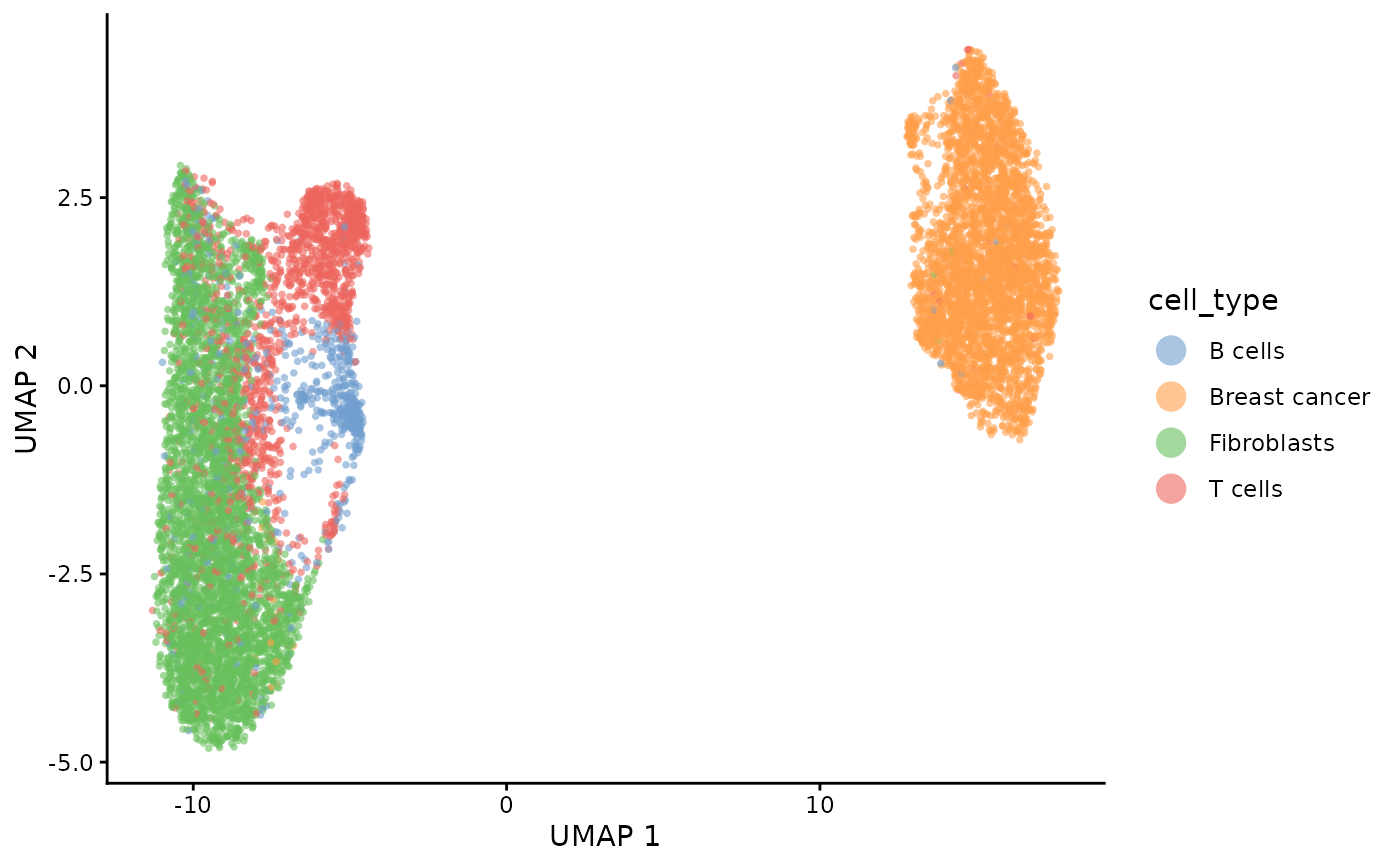
plotDR is the main function for plotting reduced dimension. Others are wrapper functions for convenience.
Usage
plotDR(
  spe,
  dimred = NULL,
  dims = c(1, 2),
  group.by = NULL,
  feature = NULL,
  assay = "counts",
  type = c("log", "raw", "cpm", "logcpm"),
  cols = NULL,
  highlight = NULL,
  cols.highlight = NULL,
  pt.shape = 16,
  pt.size = 0.7,
  pt.size.highlight = 1,
  pt.alpha = 0.6,
  label = NULL,
  xlab = NULL,
  ylab = NULL,
  cols.scale = NULL,
  ncol = NULL,
  per.scale = TRUE,
  range = NULL,
  transform = "identity"
)

plotUMAP(spe, dimred = "UMAP", ...)

plotPCA(spe, dimred = "PCA", ...)
Arguments
- spe
A SpatialExperiment object.
- dimred
Name of the reduced dimension in reducedDims
- dims
Numeric vector length 2 for the dimensions to be plotted. Default to first two dimensions
- group.by
values to group points by. Must be in colData of spe. If NULL, will try with 'cols' if available.
- feature
Feature(s) to colour points by; must be in rownames(spe). If a vector of more than one feature is supplied, one reduced-dimension panel is drawn per feature, faceted (see
ncol), with a shared colour scale.- assay
Name of assay to use for plotting feature. Default "counts".
- type
Transformation applied to feature expression: "log" (default, log2(1+x)), "raw" (no transform), "cpm", or "logcpm" (log2 CPM). For multiple features the legend title defaults to the matching unit ("log2 Cts", "Counts", "CPM", "log2-CPM"); for a single feature the unit is the legend title and the gene name becomes the plot title. Override the legend with
label.- cols
Colour palette. Can be a vector of colours or a function that accepts an integer n and return n colours.
- highlight
Optional cells to emphasise, given as either a vector of group.by levels (characters or cluster numbers), or a logical vector of length ncol(spe) selecting cells directly. Highlighted cells are drawn last (on top) at pt.size.highlight; all other cells are light grey at pt.size.
- cols.highlight
Colour(s) for the highlighted cells. Defaults to NULL, which keeps each level's usual group.by palette colour. A single colour (e.g. "red") colours all highlighted cells the same; a vector matching the number of 'highlight' entries gives one colour per level (matched by position).
- pt.shape
shape of points.
- pt.size
size of points.
- pt.size.highlight
size of highlighted points (see highlight).
- pt.alpha
alpha of points between 0 and 1.
- label
label for the legend
- xlab
label for the x-axis
- ylab
label for the y-axis
- cols.scale
vector of position for color if colors should not be evenly positioned. See scale_color_gradientn. Only applicable for continuous values.
- ncol
Number of columns when plotting multiple features. Passed to facet_wrap (shared scale) or wrap_plots (per-panel scales). Default NULL lets the layout be chosen automatically.
- per.scale
Logical. For multiple features, whether each panel gets its own colour scale (TRUE, default; like
Seurat::FeaturePlot, via the 'patchwork' package) or a single shared colour scale across panels (FALSE).- range
Numeric length-2 (lower, upper) cap for continuous colour values
a single feature, or multiple features with a shared scale; values outside are clamped. A single value is taken as the upper bound. Default NULL (no capping). Ignored when
per.scale = TRUE(each panel auto-scales).
- transform
Name of a transformation for the continuous colour scale (e.g. "log10", "log1p", "pseudo_log", "sqrt"), passed to scale_color_gradientn; the colour spectrum is spaced by the transform while the legend stays in original units. Default "identity" (no transformation). Use "log10" for nicely log-spaced legend breaks (needs positive values); "log1p"/"pseudo_log" tolerate zeros but keep linear breaks. Only affects continuous (feature or numeric group.by) colouring.
- ...
Additional arguments pass to plotDR